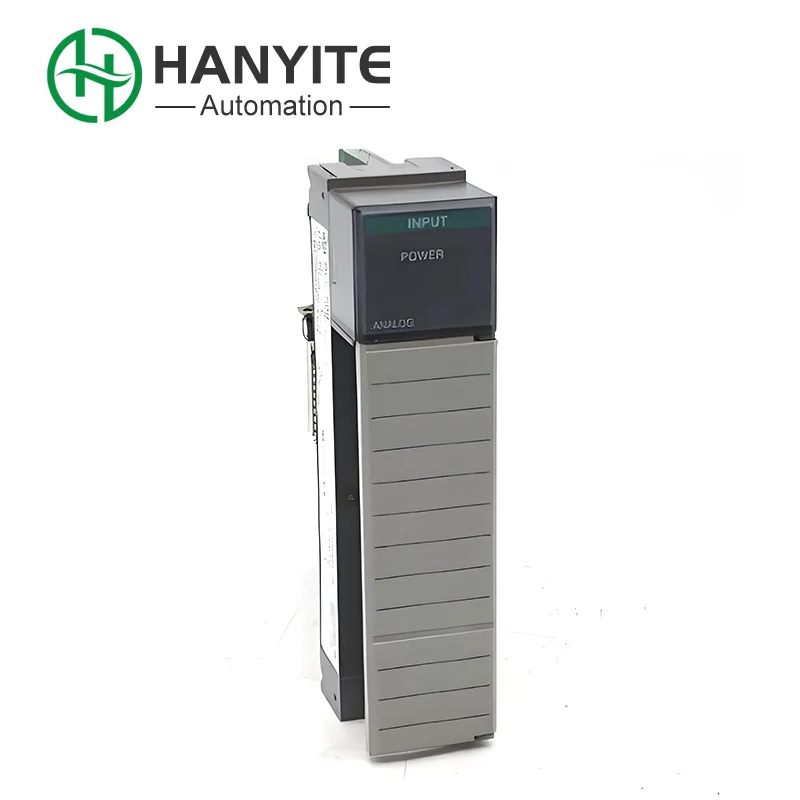

The Allen‑Bradley 1756‑A4 is a four-slot ControlLogix chassis designed by Rockwell Automation, offering a reliable and efficient platform to host controllers, I/O modules, communication adapters, and partner modules. Its sturdy backplane provides power distribution and high-speed communication, making it a backbone component in many industrial automation systems.

Here is a concise summary of its core specifications:
| Specification | Value |
|---|---|
| Form Factor | 4-slot chassis (ControlLogix) |
| Minimum Enclosure Size | 50.8 cm × 50.8 cm × 20.3 cm (20 × 20 × 8 in) |
| Weight | Approx. 0.75 kg (1.7 lb) |
| Mounting Method | Horizontal only |
| Backplane Current (Max per Slot) |
– 1.2 V DC: 1.5 A – 3.3 V DC: 4 A – 5.1 V DC: 6 A (slot), 15 A (chassis) – 24 V DC: 2.8 A |
| Power Dissipation | Typically ~4 watts |
| Operating Temperature | 0°C to +60°C |
| Storage Temperature | –40°C to +85°C |
| Certifications / Standards | IEC 60068 series, CSA, CE, KC (KCC) |
The 1756-A4 chassis provides physical slots to mount up to four modules, including controllers (such as Logix CPUs), I/O modules, and specialty modules.
It offers a backplane that distributes power (e.g., 1.2 V, 3.3 V, 5.1 V, 24 V) to all connected modules, enabling coherent operation.
It enables high-speed data transfer among modules via the backplane, essential for real-time control and communication.
The chassis supports “Removal and Insertion Under Power (RIUP)” — allowing modules to be hot-swapped, which reduces downtime.
Electronic keying is implemented in its design to prevent incorrect module insertion, reducing human error during maintenance.
The 1756-A4 chassis has been widely used in industrial automation systems for years, making it a proven and trusted component. It supports mature ControlLogix architectures, which many plants still rely on.
Its rugged construction and operating temperature range ensure it functions well in harsh industrial environments.
Certifications like IEC, CSA, and CE provide assurance to operations teams about its safety and compliance.
By providing a robust backplane with multiple voltage rails, the chassis ensures that power supply to all modules is consistent and stable. This reduces the risk of module failures caused by power inconsistency.
The chassis’s efficient power dissipation (only a few watts) helps minimize heat generation, which contributes to system reliability.
With four available slots, the 1756-A4 gives system designers flexibility in module arrangement — combining CPUs, I/O modules, specialized communication or partner modules.
The hot-swap (RIUP) capability means modules can be added, removed, or replaced without shutting down the entire system, reducing downtime and improving maintainability.
Using a standard chassis across multiple control panels or machines reduces spare parts inventory.
Its long lifecycle and compatibility with widely deployed ControlLogix modules make it a cost-effective investment.
The 1756-A4 can be part of a distributed I/O architecture. Using communication adapters (e.g., Ethernet/IP adapters), remote chassis can be networked, enabling flexible system expansion.
This modularity supports phased upgrades and helps minimize capital expenditure by reusing existing infrastructure.
Mounting: The chassis must be mounted horizontally in an appropriate panel, ensuring enough space for ventilation and access to modules.
Power Connection: A compatible ControlLogix power supply is connected to supply backplane voltages. Care must be taken to size the supply to the expected module load.
Module Insertion: Modules (CPUs, I/O, communication, partner) are inserted into the slots. Electronic keying ensures modules fit only in compatible slots, reducing miswiring risk.
Backplane Communication: Once inserted, modules communicate via the backplane for data transfer and synchronization.
Hot-Swap Operations (RIUP): When replacing or inserting modules while system is powered, the RIUP capability ensures minimal disturbance to running modules.
Monitoring Backplane Current: By checking the backplane current usage at different voltages (1.2V, 3.3V, 5.1V, 24 V), engineers can ensure modules do not overload the chassis or power supply.
Thermal Management: Even though the chassis dissipates low power, proper panel design and ventilation are important to avoid hotspots.
Firmware & Module Updates: Modules like CPUs or communication adapters can receive firmware updates without removing the chassis; thanks to hot-swap support, updates can often be done with minimal disruption.
Spare Strategy: It is efficient to keep a spare 1756-A4 chassis or spare modules to quickly replace in case of failure, optimizing uptime.
Distributed I/O: In systems where I/O needs to be geographically distributed, the 1756-A4 chassis can be deployed at remote sites with a communication adapter to link back to a central controller.
Redundancy: For critical applications, chassis can be paired with redundant power supplies and redundant communication paths to minimize risk.
Scalable Expansion: As control needs grow, additional chassis (like another 1756-A4) can be added without redesigning the entire control architecture. This modular approach reduces both upfront engineering effort and long-term costs.
Many industrial facilities still run legacy ControlLogix systems. The 1756-A4 chassis ensures backward compatibility, helping companies protect their existing investments.
As companies modernize, the chassis can serve as a bridge, enabling phased migration rather than wholesale replacement. Engineers can gradually replace CPUs and I/O modules while retaining the chassis.
With increasing adoption of edge computing, the 1756-A4 can host edge-capable controllers or partner modules that support data aggregation, analytics, or pre-processing at the machine level.
Communication modules (e.g., Ethernet/IP, Profinet) installed in the 1756-A4 can link to higher-level IIoT platforms, enabling real-time data flow for predictive maintenance and smart manufacturing.
The chassis’s low power dissipation aligns with sustainability goals and energy-efficient industry design.
Modular, hot-swappable capability reduces waste by enabling selective replacement of failed modules rather than discarding entire racks.
The 1756-A4 is commonly refurbished and repaired, extending its useful life. This supports circular economy principles and cost-efficient operations.
Service providers can replace worn connectors, update keying, or certify used chassis for reuse, aligning with both financial and environmental goals.
Q1: What is the maximum number of modules that the 1756-A4 chassis supports?
A1: The 1756-A4 chassis supports up to four modules. It includes a four-slot backplane designed to accommodate a variety of ControlLogix modules such as CPUs, I/O, specialty, or communication adapters.
Q2: Can modules be hot-swapped in the 1756-A4 chassis?
A2: Yes, the chassis supports Removal and Insertion Under Power (RIUP), allowing modules to be removed or inserted while the system is operating, minimizing downtime for maintenance.
From a professional and long-term automation perspective, the Allen-Bradley 1756-A4 chassis remains a foundational building block for ControlLogix-based systems. Its blend of reliability, modularity, power efficiency, and broad industry adoption makes it an enduring choice in both new installations and legacy system upgrades.
What it is: a 4-slot chassis with robust backplane power and communication capabilities.
Why it remains valuable: proven design, hot-swap support, cost efficiency, and flexibility in system architecture.
How it works: via reliable power distribution, module keying, high-speed communication, and maintainable design.
Future trends: migration strategies, edge computing integration, sustainability, and lifecycle extension make it relevant for years to come.
For enterprises seeking to optimize or expand their automation infrastructure, leveraging the 1756-A4 chassis as part of a scalable and modular ControlLogix strategy is a smart long-term decision.
Hanyite is a trusted provider of industrial automation solutions and can support your deployment, upgrade, or refurbishment needs for ControlLogix components including the 1756-A4 chassis. Contact us to discuss how Hanyite can help you integrate this chassis into your systems securely and efficiently.